
What Is an Out-of-Body Experience?
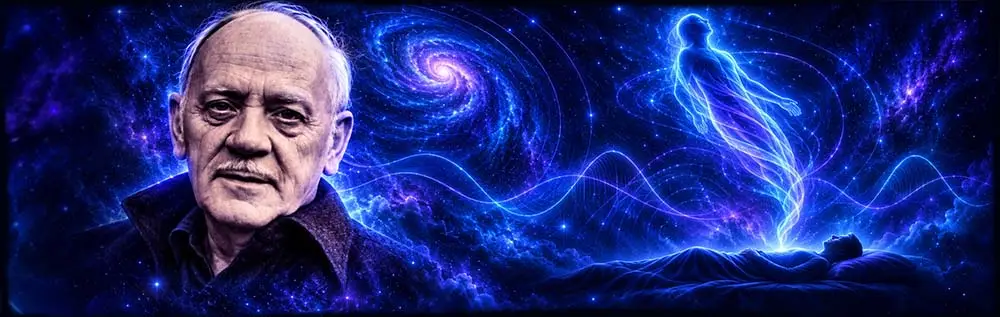
An out-of-body experience (OBE) is the vivid sense that your awareness (your mind) has separated from your physical body. People describe seeing the room from the ceiling, drifting through familiar spaces, or moving into places that feel entirely new.
It’s more common than you’d think. Surveys across many countries suggest roughly one in ten people report having at least one. Most happen spontaneously: at the edge of sleep, during deep relaxation, in meditation, or in moments of extreme stress.
For most people, it happens once and becomes a story they rarely tell. But what if it didn’t have to be an accident? What if it could be learned?
That question has driven one of the most unusual journeys of discovery of the last century.
The Businessman Who Started Leaving His Body
In 1958, Robert Monroe was a successful radio broadcasting executive in New York. He wasn’t a mystic, and he wasn’t looking for anything unusual.
Then, while lying down to rest, he began to experience strange vibrations, followed by the unmistakable sensation of floating free of his body. It kept happening. Afraid he was ill, he saw doctors and a psychologist. They found nothing wrong.
So Monroe did what a practical man does: he started taking notes. Over the next decade he documented hundreds of experiences, and in 1971 he published Journeys Out of the Body. The book helped bring the term “out-of-body experience” into popular use.
But Monroe wanted more than a memoir. He wanted a method. Drawing on his background in audio, he began experimenting with sound to guide the mind into specific states of consciousness. That work led to the founding of the Monroe Institute in the foothills of Virginia’s Blue Ridge Mountains, where it still operates today.
Why Did U.S. Army Intelligence Take This Seriously?
Here’s where the story takes a turn most people don’t expect.
During the Cold War, U.S. intelligence agencies were investigating anything that might offer an edge, including the possibility that the human mind could gather information beyond the normal senses. Monroe’s work caught their attention, and Army intelligence personnel attended programs at the Monroe Institute.
In 1983, Lieutenant Colonel Wayne McDonnell of the U.S. Army wrote a detailed assessment titled Analysis and Assessment of Gateway Process. In it, he tried to explain Monroe’s Gateway Experience in the language of physics and biology, from brainwave patterns to the nature of consciousness itself.
The report was later declassified and made public through the CIA’s records archive (document CIA-RDP96-00788R001700210016-5). For years it sat almost unnoticed. Then, in 2021, it went viral, and millions of people discovered that the military had once studied a technique for expanding consciousness.
This interest sat alongside the government’s wider psychic research, best known today as the Stargate Project. That program was shut down in 1995 after an independent review concluded it had no proven value for intelligence work. So the honest takeaway isn’t “the CIA proved it works.” It’s this: serious people, with serious budgets, thought it was worth investigating.
Link to original CIA pdf document on the CIA website.
What Science Says (and What It Doesn’t)
Science hasn’t settled what an OBE is. But researchers agree on something important: the experience itself is real, and the brain can produce it.
- It can be triggered in the lab. In 2002, neuroscientist Olaf Blanke and colleagues reported that stimulating a specific region of the brain, near the temporoparietal junction, produced OBE-like sensations in a patient.
- It can be induced with technology. Later studies used virtual reality to make volunteers feel as if they were located outside their own bodies.
- It’s linked to the edge of sleep. Many spontaneous OBEs happen in the transition between waking and sleeping, the same doorway Monroe’s methods are designed to hold open.
Whether consciousness actually travels, or the brain builds a convincing new point of view, remains an open question. That’s part of what makes this territory so compelling: you can explore it for yourself and draw your own conclusions.
The Map: Hemi-Sync and the Focus Levels
Monroe’s breakthrough was Hemi-Sync, an audio technology built on binaural beats. Each ear hears a slightly different tone, and the brain perceives a third “beat” between them. The aim is to gently guide the mind into specific, repeatable states.
To make those states easier to navigate, Monroe gave them numbers. He called them Focus Levels:
- Focus 10: Mind awake, body asleep. The body relaxes deeply while awareness stays clear. This is the foundation for everything that follows.
- Focus 12: Expanded awareness. Perception opens beyond the usual physical senses.
- Focus 15: No time. A state where the sense of time falls away.
- Focus 21: The bridge. The edge of ordinary reality, and the gateway to deeper exploration.
Think of them as rungs on a ladder. You don’t jump to the top. You learn each level, step by step, until moving between them feels natural.
Your Exploration Starts Here
You don’t need a special gift. You need curiosity, a quiet space, and a structured way in. Choose your path:
1. Learn the basics first.
Our step-by-step OBE series takes you from your first relaxation session to your first conscious exploration.